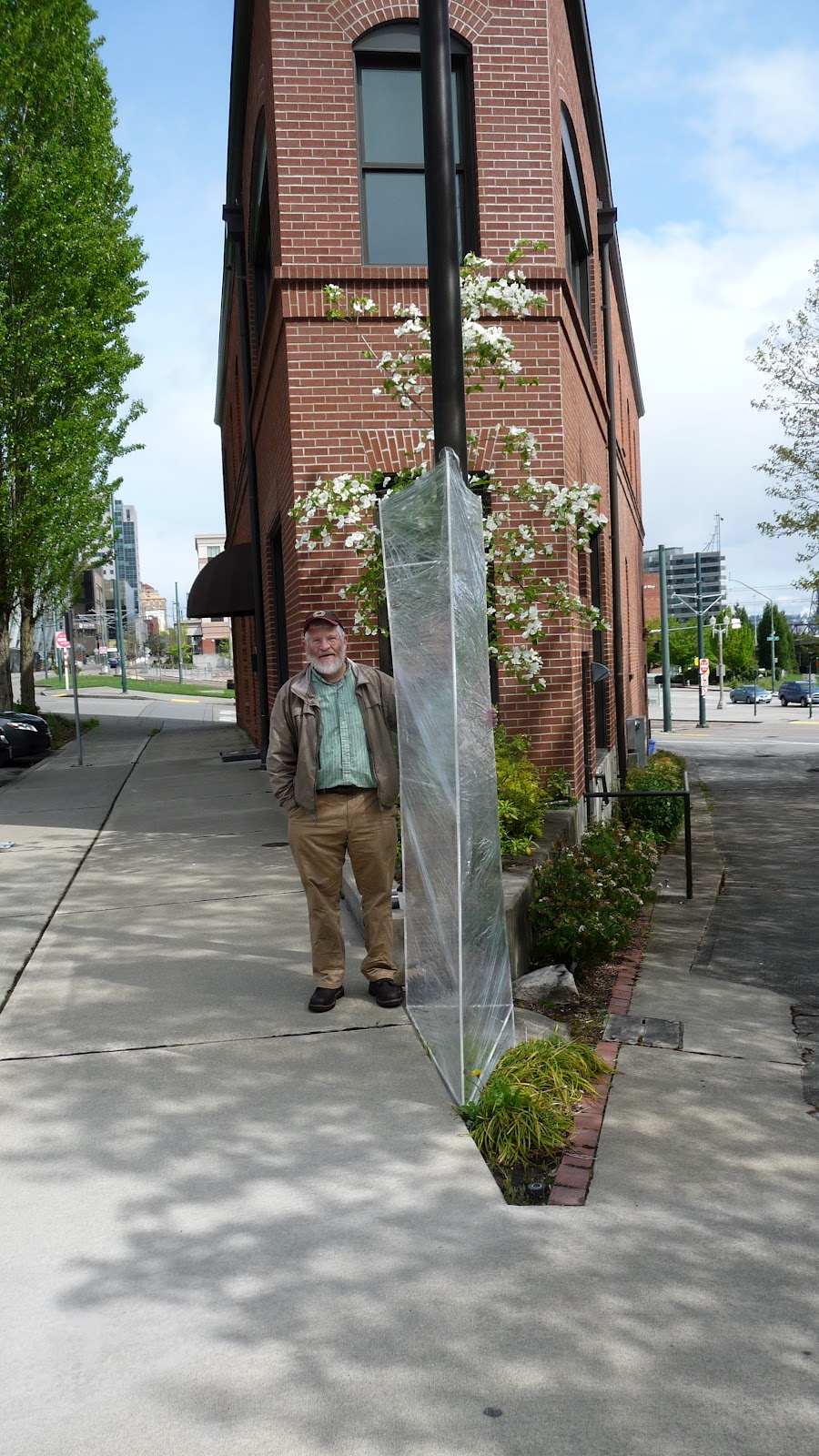
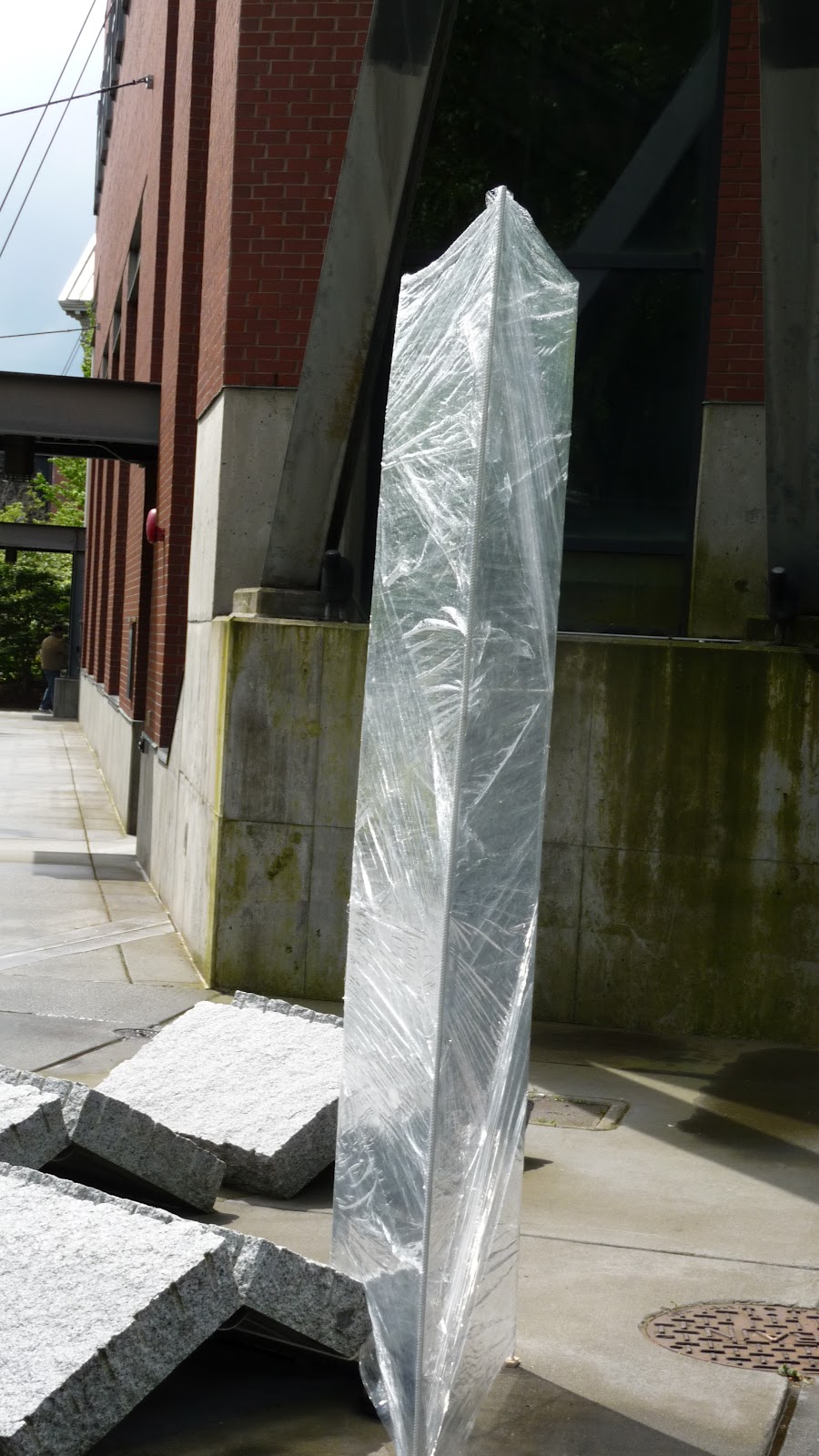
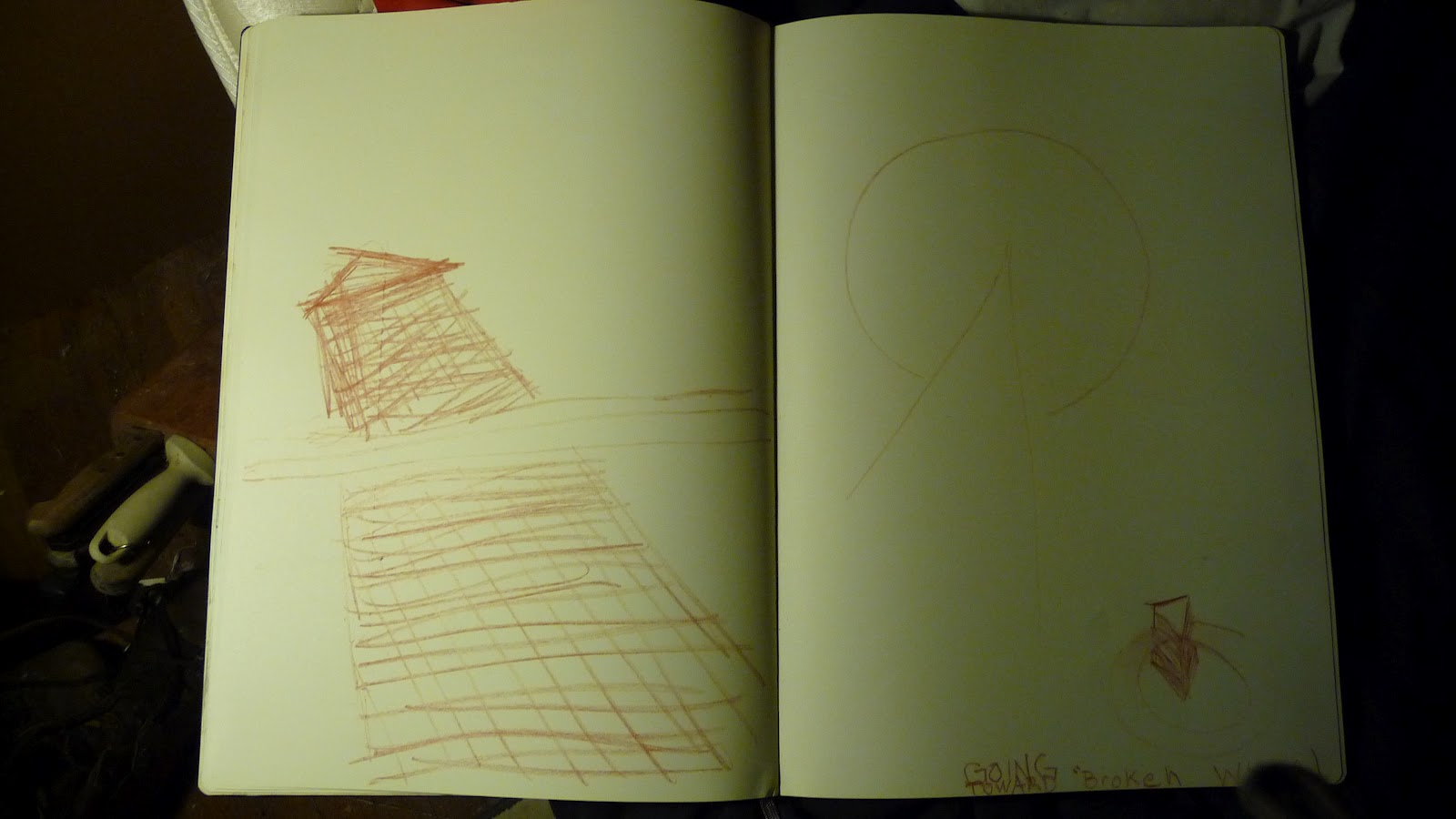
For me this project, while fulfilling as a model of two sculptures, seems unfinished without the plaza or center of interaction between these twin sculptures. I would like to design a plaza for this spot as the joining. The twin lights acting as sentinels for a wheel plaza like an unfinished space station that generates its own gravity by slowly spinning. Of course a plaza could not spin, but spoke like structures radiating from a central hub and corresponding to natural passages between buildings and walkways could anchor this auxiliary busy-spot.
I enjoy the light reflections in these 2 pictures; it looks like a person made of light dancing.
Monday, May 7, 2012
Monday, April 30, 2012
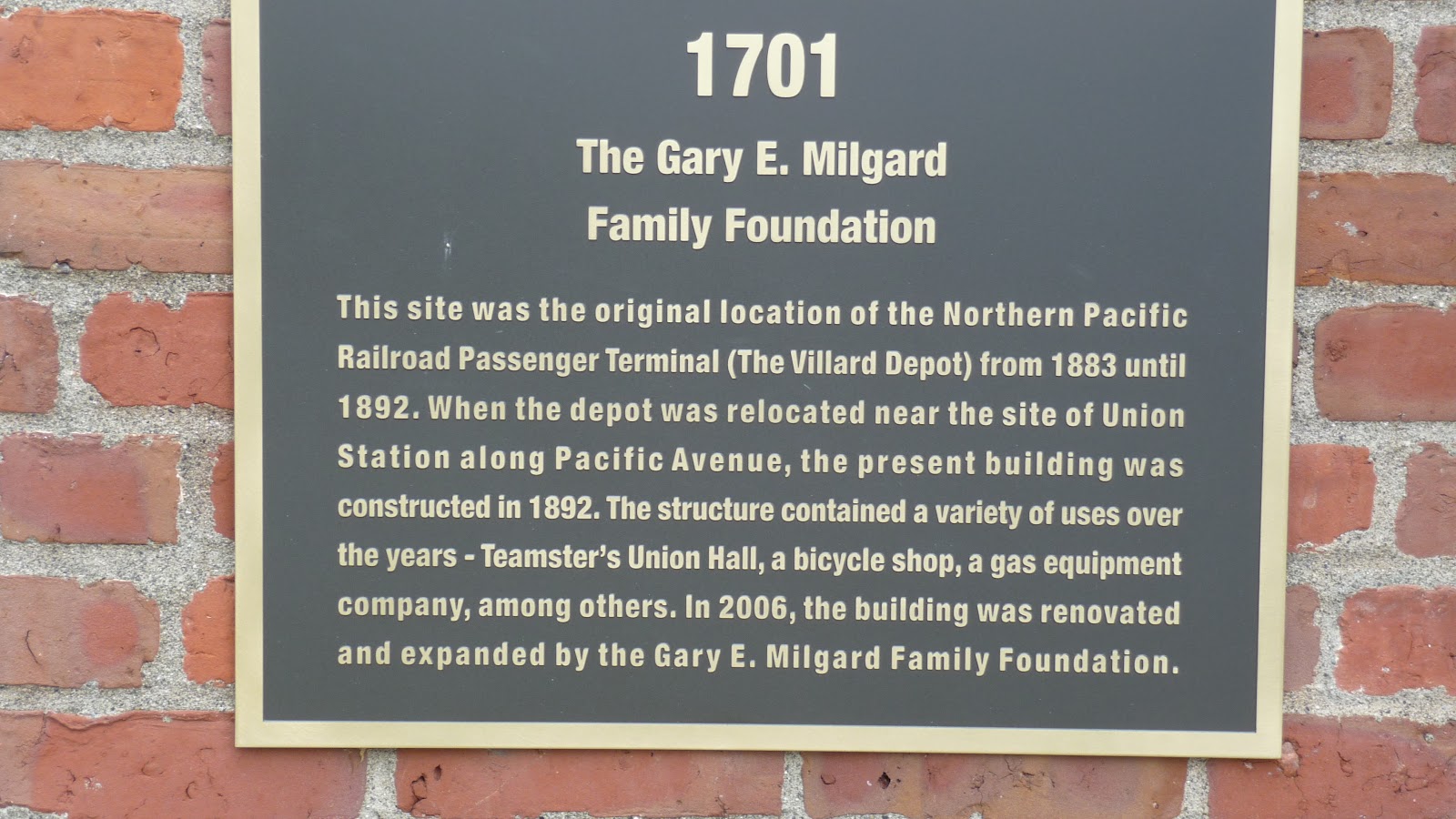
The Milgard Family
Trust is currently housed in the
building at 1701 Commerce . This last building on campus before Tollefsen
Plaza was the site of the first passenger terminal in Tacoma for the Northern
Pacific Railroad before it was moved across Pacific Avenue in 1892 to the site
where Union Station ,erected in 1911, now stands as part of the Federal Court
House. The Villard Depot served the
train passenger community from 1883 until 1992. The Milgard Family Trust is
named for Gary Milgard who selected as a permanent member by the Horatio Alger
Association Of Distinguished Americans in 2003. The members of this association
mentor young and provide scholarships to high school seniors who have proven their
ability to overcome childhood adversities and humble beginnings.
The building we
see today was originally built in 1894 as the Teamsters and Chauffeurs hall
which they used as their hiring hall for half a century. Merit Architects bought the Teamsters hiring
hall in 1979 and remodeled the building, a project that lasted three years, and
used it as their architectural offices until the University of Washington
Tacoma required the property for their
expansion. A number of other businesses occupied the building over the years
including a bicycle shop, a sheet metal fabricator, and Pettit Oil Company,
affiliated with Standard Oil, it apparently operated a number of Chevron
Stations in the area including one across 17th Street which occupied a portion of what is now
Tollefsen Plaza.
The shape and size
of the building were determined by the property set-backs of the time, 1894,
when it was built. Hence, the triangular shape forced by 17th
Street, Commerce Street and the Railroad’s Hood corridor all of which are
easily identifiable today. This wedge shape often referred to as a keystone
building
because of its
resemblance to the center topmast stone in a masonry arch stands today
reflected in the University of Washington Tacoma’s Keystone Building. These two
keystone building form a unique relationship in my experience as they point
toward each other. While there are numerous keystone building in Tacoma and
across America this is the only place, again by my experience, where two of
them sit in this juxtaposition. Both buildings are defined by commerce, 17th
and Hood corridor. They appear like spokes
to a circle or as if forming their own intersection which could be
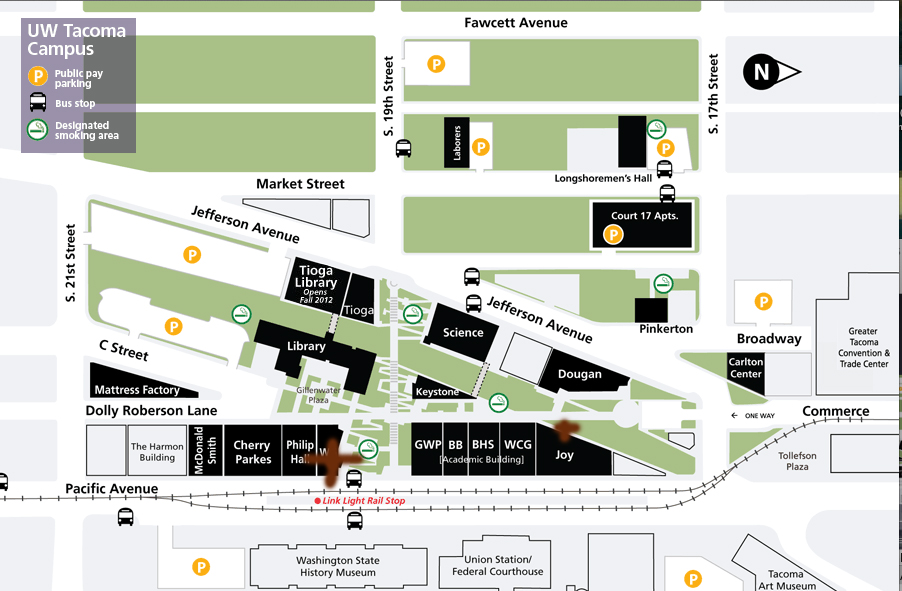
expanded to include connections with Duggan Hall, West Coast Grocery building and the Joy building. This crossroads
is demarked by the railroad crossing signal warning towers seems like a natural
for a small square or CIRCLE for the
University landscape. Many shapes can form a matrix for building construction
as well as plazas, decks, and contrived landscape features including the
square, the rectangle, the hexagram and the circle as well as the nodal points
of intersecting circles.
With four of the various occupants of 1702 Commerce having business that involve wheels: The teamsters were driving horse drawn wagons before trucks; the train depot depended on the wheels of trains; The bicycle shop; and the Chevron business required cars and trucks, it seems fitting that a design would include circles, wheels or some combination or intersection of such.
Monday, April 23, 2012
history project
The site I have chosen was inspired by the Milgard Family Trust building located at the edge of campus where Commerce street is once again opened to traffic albeit one way at this point. 1701 Commerce is the address. Originally this was the site of the passenger terminal for the Northern Pacific Railroad in 1889 before Union Pacific bult the terminal across the street in 1902. The terminal was moved in 1894 and the building we see today was built in 1894 and first housed the Teamsters Union hiring hall, remember this was still when teamsters drove a team of horses hitched to a wagon not trucks. Subsequent uses for the building include a bicycle shop and a automobile service station. I wanted to include the wheel in this site specific installation while focusing attention on the keystone shape of the building. While communing with the site, taking pictures and making contact with the spirits of the site, I became aware of the similarity of our own Keystone building. an enlarged reflection of the Teamsters Hall.
These two buildings are like arrows pointing toward each other; so naturally I undertook to determine the vector point of their intersection.
The three parts of this history project seek to integrate the buildings, bring awareness to their harmony. Two vertical cellophane, glass like, triangles will be placed to complete the imagined point of their respective shapes while the point of their intersection will be demarcated by a circle or wheel on the edge of the walkway which leads the pedestrian from WCG to Dugan.
These two buildings are like arrows pointing toward each other; so naturally I undertook to determine the vector point of their intersection.
The three parts of this history project seek to integrate the buildings, bring awareness to their harmony. Two vertical cellophane, glass like, triangles will be placed to complete the imagined point of their respective shapes while the point of their intersection will be demarcated by a circle or wheel on the edge of the walkway which leads the pedestrian from WCG to Dugan.
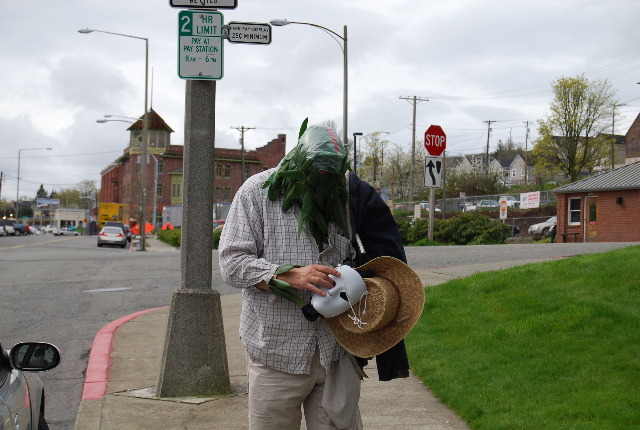
I would have liked for the green areas to multiply with time, like a five oclock shadow dealing with limbs and leaves. The gloves should be white like the mask and maybe a different hat; or no hat, but the hat is an important element of concealment of the costume. A hat made to look like a stump would have worked and could have started under the straw hat. I contemplated painting the mask but decided white was more generic, of course I didn't know how many other classmates would also wear the same mask. I think the normal human condition involves 'layers' layers of personality and different roles we play in varying situations. We are nature although many try to deny this clothing themselves in various forms, including makeup to distance their appearance.
I am continuously reminded that I don't resemble the norm of students and am subsequently aware of my otherness as an older student. I may go long periods in unawareness but something brings me back; this is a big part of what I meant to portray. I look at these pictures and think I look pretty interesting and I never intended to wear the mask of white throughout the entire time, donning it to hide from new people who would see me.
Wednesday, April 18, 2012
Monday, April 9, 2012
Site specific? Over thinking this, as I am often accused, I am entangled with wishing to do spectacular art and not knowing how. I think integrating with a site is about 'feeling' site specificity, really going into the site with my own spirit in order to harmonize with the existent. I chose a site in nature because I feel the most at home in nature settings, they nurture me, though I immediately wanted to hide myself, camouflaged into the scene, in rereading the assignment it seemed that was not what was actually asked for. In my daily life on campus I often feel misplaced, not actually belonging. My natural look seems to be out of place; so I thought to disguise myself as a student, a younger version to fit better. At the same time I continued to explore blending with nature and came up with the idea that I am already a part of nature. By taking that reality and representing myself as burgeoning nature trying to stay bottled and coming into to man's environment and trying to fit.; man has tried so long to set himself apart and above nature he has had a partial success, so that he himself has become artificial.
My concept then is to show nature trying to escape from the mask of false humanity while at the same time me, as a construct of nature, is trying to fit in. The concept then is for a mask to hide my natural self while nature, represented by leaves, is emerging around the edges of the mask and clothing. Like a green man donning clothes and a mask. The invisible man, the phantom of the opera, the man behind the mask, and the beast of beauty and the beast all exemplify in different ways. This would best be performed as a part of a class.
Materials; mask, leaves, hat, and some sort of hairnet, oh and glue.
Subscribe to:
Posts (Atom)


.png)